Solution Guide · AI-Powered Legacy Modernization
Engineering What's Next: AI-Powered Legacy Modernization
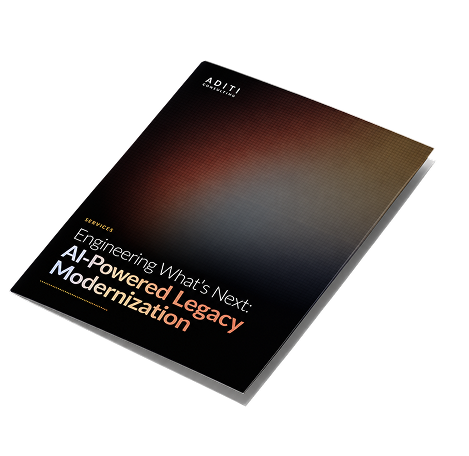
Fill Out the Form to Access the Guide
The guide opens after submission.
REDUCE LEGACY DRAG
Lower maintenance burden and operational friction.
MOVE FASTER
Make critical systems easier to change with confidence.
RECOVER ENGINEERING CAPACITY
Give teams more time to build what’s next.
The Legacy Constraint
When Legacy Systems Slow the Business, It’s Time to Act.
Legacy technology becomes a constraint when it starts consuming too much time, talent, and budget—or makes reliability, security, delivery, cloud, and AI harder to improve. This includes:
Maintenance Burden
Recurring support and workarounds keep engineering capacity tied to business-as-usual work.
Knowledge Risk
Critical logic and dependencies can become trapped in outdated documentation or a handful of experienced people.
Change Friction
When teams can’t see how systems connect, even small changes become slower, riskier, and harder to validate.
What's Inside
An AI-Powered Solution to Modernizing With Confidence
Understand when legacy systems become a real constraint, where AI can accelerate the work, and how to choose a starting point that fits your environment.
Know When Modernization Is Worth It
Identify where maintenance, skill scarcity, slow delivery, risk, or barriers to cloud and AI are creating measurable drag.
See Where AI Can Accelerate the Work
Learn how AI-enabled discovery, dependency mapping, analysis, and documentation can help teams understand complex systems faster.
Choose the Right Starting Point
Determine whether you need greater visibility before change—or operational relief while building toward modernization.
Modernization Begins With Understanding
You Can’t Modernize What You Don’t Understand
Before deciding what to retain, refactor, replatform, rebuild, or replace, teams need visibility into the business logic, dependencies, and risks inside the current environment. AI can accelerate discovery and documentation. Engineers determine what the findings mean, what should change, and where investment will create the most value.
Two Starting Paths
Start With the Problem You Need to Solve First
Modernization doesn’t have one starting point. Some organizations need clarity before committing to change. Others need immediate relief from the burden of running the current environment.
Path A — Discovery-First Modernization
When you need clarity before change
Use AI-enabled discovery to surface application logic, dependencies, business rules, and risk before making major modernization decisions.
Outcome: Greater visibility and decision confidence.
Path B — Operate-to-Modernize
When you need relief now
Stabilize and manage the legacy environment while building the documentation and system knowledge needed to modernize deliberately.
Outcome: Lower operational burden and greater stability.
Aditi’s Starting Framework
Start Your Modernization Project with a Clear Path
Three Decisions Before You Modernize
The oldest system isn’t automatically the first one that should change. Start with the outcome the current environment is making hardest to achieve.
What needs to improve: cost, reliability, speed, risk, AI readiness, or engineering capacity?
Which applications, dependencies, or operating burdens are preventing that improvement?
Do you need greater visibility first—or immediate stability while you build toward modernization?
FAQ
Putting Legacy Modernization Into Practice
No. The right answer may be to document, refactor, replatform, rebuild, or replace. The approach should follow the constraint and outcome—not a predetermined technology path.
AI can accelerate repeatable work such as code discovery, dependency mapping, analysis, and documentation. Engineers remain responsible for architecture, validation, governance, and modernization decisions.
Prioritize the systems creating the greatest business impact, operational burden, risk, or constraint. The oldest application is not necessarily the highest priority.
Start with discovery. Visibility into application logic, dependencies, business rules, and risk gives teams a stronger basis for deciding what should change.
Get the Guide
Remove the Constraints. Create Capacity for What's Next.
Learn how to understand your legacy environment, identify where change will create the most value, and use AI to accelerate modernization without replacing engineering judgment.
Get the guideStill want to continue exploring?